
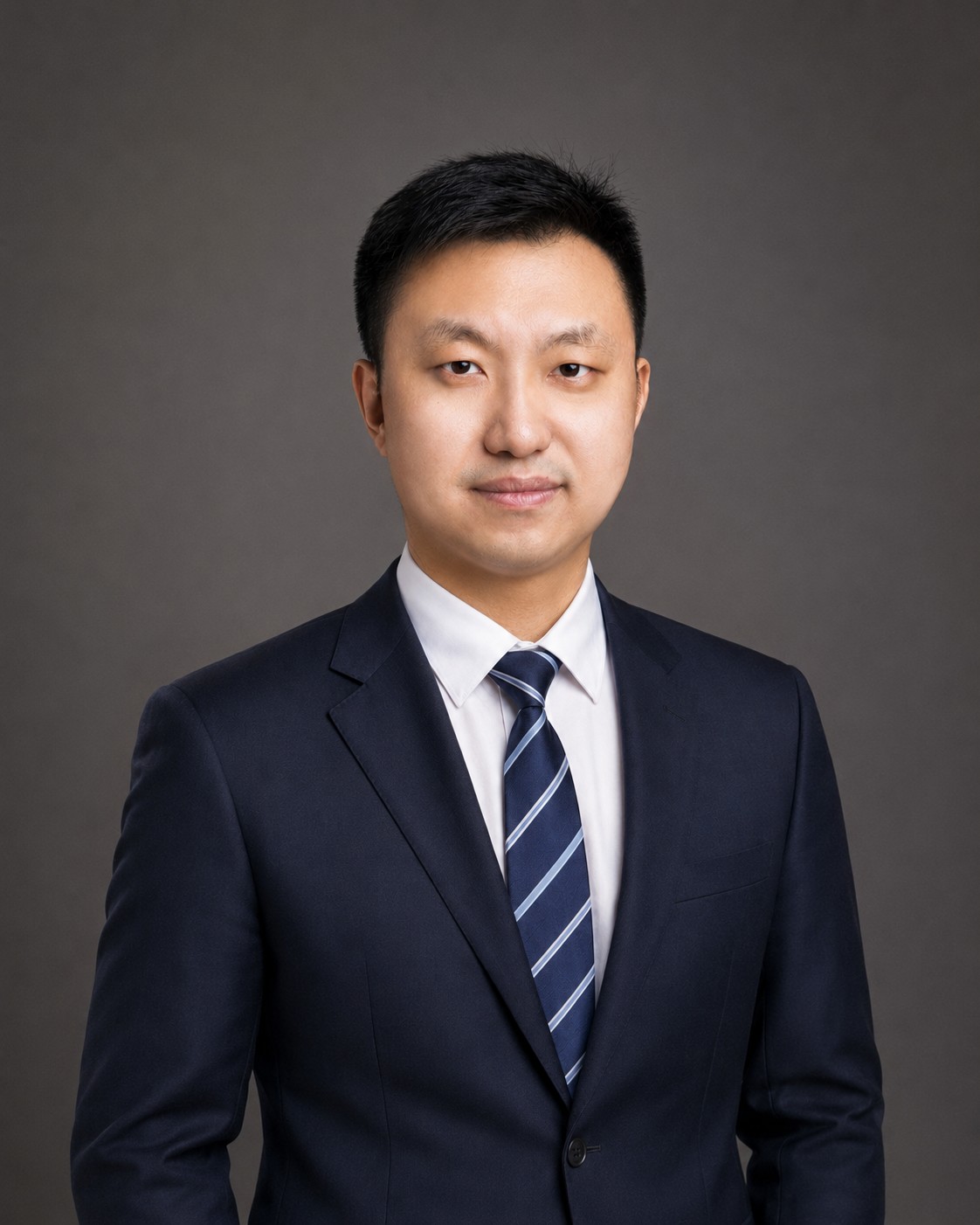
Yin Cao
Professor, Institute of Acoustics, Chinese Academy of Sciences
Email: caoyin@mail.ioa.ac.cn
Address: No. 21 North 4th Ring Road West, Haidian District, Beijing, China
Yin Cao is a Professor at the Institute of Acoustics, Chinese Academy of Sciences. His research lies at the intersection of intelligent acoustics, spatial audio, machine listening, audio and speech artificial intelligence, and multimodal machine learning. His recent work focuses on spatial audio understanding and generation, sound event localization and detection, audio-language foundation models, speech enhancement and source separation, generative audio modeling, and acoustic content security.
Research Areas
My research broadly focuses on intelligent acoustics, spatial audio understanding and generation, audio and speech artificial intelligence, and multimodal machine learning. I am interested in developing intelligent acoustic systems that can perceive, understand, reason about, reconstruct, and generate complex acoustic scenes.
- Intelligent acoustics and machine listening
- Spatial audio perception, understanding, and generation
- Sound event detection and localization
- Audio and speech foundation models
- Audio-language alignment and audio question answering
- Speech enhancement, source separation, and target speaker extraction
- Generative audio and acoustic content security
- Audio-driven multimodal learning and intelligent acoustic systems
Education
- Ph.D., Institute of Acoustics, Chinese Academy of Sciences, 2008–2013
- B.Sc., Nanjing University, 2004–2008
Professional Experience
- Professor, Institute of Acoustics, Chinese Academy of Sciences, 2026–present
- Associate Professor, Xi’an Jiaotong-Liverpool University, 2022–2026
- Senior Staff Researcher, Qualcomm Inc., 2020–2022
- Research Fellow, University of Surrey, 2018–2020
- Research Staff, Institute of Acoustics, Chinese Academy of Sciences, 2017–2018
- Postdoctoral Researcher, Brigham Young University, 2013–2015
Publications
Papers
1. WavJourney: Compositional Audio Creation with Large Language Models. IEEE/ACM Transactions on Audio, Speech, and Language Processing, 2025.
2. Face2VoiceSync: Lightweight Face-Voice Consistency for Text-Driven Talking Face Generation. Interspeech, 2025. Corresponding author.
3. PSELDNets: Pre-trained Neural Networks on a Large-Scale Synthetic Dataset for Sound Event Localization and Detection. IEEE/ACM Transactions on Audio, Speech, and Language Processing, 2025. Corresponding author.
4. DiffStereo: End-to-End Mono-to-Stereo Audio Generation with Diffusion Transformer. Interspeech, 2025.
5. EDTC: Enhanced Depth of Text Comprehension in Automated Audio Captioning. The Computer Journal, 2025. Corresponding author.
6. Selective-Memory Meta-Learning with Environment Representations for Sound Event Localization and Detection. IEEE/ACM Transactions on Audio, Speech, and Language Processing, 2024. Corresponding author.
7. WavCraft: Audio Editing and Generation with Large Language Models. ICLR 2024 Workshop on LLM Agents, 2024.
8. Power Cue Enhanced Network and Audio-Visual Fusion for Sound Event Localization and Detection of DCASE 2024 Challenge. DCASE 2024 Challenge Technical Report, 2024.
9. Text-Queried Target Sound Event Localization. EUSIPCO, 2024.
10. Meta-SELD: Meta-Learning for Fast Adaptation to New Environments in Sound Event Localization and Detection. Detection and Classification of Acoustic Scenes and Events Workshop, 2023.
11. PLDISET: Probabilistic Localization and Detection of Independent Sound Events with Transformers. Detection and Classification of Acoustic Scenes and Events Workshop, 2023.
12. A Data Generation Method for Sound Event Localization and Detection in Real Spatial Sound Scenes. DCASE 2023 Challenge Technical Report, 2023.
13. Statistical Analysis of Multichannel FxLMS Algorithm for Narrowband Active Noise Control. Signal Processing, 2022.
14. Sound Event Localization and Detection for Real Spatial Sound Scenes: Event-Independent Network and Data Augmentation Chains. Detection and Classification of Acoustic Scenes and Events Workshop, 2022.
15. Robust Parallel Virtual Sensing Method for Feedback Active Noise Control in a Headrest. Mechanical Systems and Signal Processing, 2022.
16. Modified Narrowband Active Noise Control System with Frequency Mismatch Tolerance. Applied Acoustics, 2022.
17. Multichannel Narrowband Active Noise Control System with a Frequency Estimator Based on DFT Coefficients. Journal of Sound and Vibration, 2022.
18. Echo Cancellation and Noise Suppression by Training a Dual-Stream Recurrent Network with a Mixture of Training Targets. IEEE Workshop on Applications of Signal Processing to Audio and Acoustics, WASPAA 2021.
19. A Track-Wise Ensemble Event-Independent Network for Polyphonic Sound Event Localization and Detection. IEEE International Conference on Acoustics, Speech and Signal Processing, ICASSP 2022.
20. Frequency-Dependent Auto-Pooling Function for Weakly Supervised Sound Event Detection. EURASIP Journal on Audio, Speech, and Music Processing, 2021.
21. ARCA23K: An Audio Dataset for Investigating Open-Set Label Noise. Detection and Classification of Acoustic Scenes and Events Workshop, 2021.
22. Decoupling Magnitude and Phase Estimation with Deep ResUNet for Music Source Separation. International Society for Music Information Retrieval Conference, ISMIR 2021.
23. An Improved Event-Independent Network for Polyphonic Sound Event Localization and Detection. IEEE International Conference on Acoustics, Speech and Signal Processing, ICASSP 2021.
24. Optimized Decentralized Filtered-X Least Mean Square Algorithm for Over-Determined Systems with Periodic Disturbances. Journal of Sound and Vibration, 2021.
25. Source Separation with Weakly Labelled Data: An Approach to Computational Auditory Scene Analysis. IEEE International Conference on Acoustics, Speech and Signal Processing, ICASSP 2020.
26. PANNs: Large-Scale Pretrained Audio Neural Networks for Audio Pattern Recognition. IEEE/ACM Transactions on Audio, Speech, and Language Processing, 2020. Corresponding author.
27. Incorporating Auxiliary Data for Urban Sound Tagging. DCASE 2020 Challenge Technical Report, 2020.
28. Learning with Out-of-Distribution Data for Audio Classification. IEEE International Conference on Acoustics, Speech and Signal Processing, ICASSP 2020.
29. Event-Independent Network for Polyphonic Sound Event Localization and Detection. Detection and Classification of Acoustic Scenes and Events Workshop, 2020.
30. Generalisation in Environmental Sound Classification: The “Making Sense of Sounds” Dataset and Challenge. IEEE International Conference on Acoustics, Speech and Signal Processing, ICASSP 2019.
31. Acoustic Scene Generation with Conditional SampleRNN. IEEE International Conference on Acoustics, Speech and Signal Processing, ICASSP 2019.
32. Polyphonic Sound Event Detection and Localization Using a Two-Stage Strategy. Detection and Classification of Acoustic Scenes and Events Workshop, 2019.
33. Experimental Validation of Virtual Absorbed Energy of Piezoelectric Patch Actuators in Decentralized Velocity Feedback Control of a Plate. Journal of Sound and Vibration, 2015.
34. An Analysis of Control Using the Weighted Sum of Spatial Gradients in Active Structural Acoustic Control for Flat Panels. The Journal of the Acoustical Society of America, 2015.
35. Active Structural Acoustic Control of Plates with Different Boundary Conditions Using a Weighted Sum of Spatial Gradients. The Journal of the Acoustical Society of America, 2014.
36. Virtual Absorbed Energy in Decentralized Velocity Feedback Control of a Plate with Piezoelectric Patch Actuators. Applied Acoustics, 2013.
37. Active Control of Low-Frequency Sound Radiation by a Cylindrical Shell with Piezoelectric Stack Force Actuators. Journal of Sound and Vibration, 2012.
Prospective Students
I am looking for highly motivated students interested in intelligent acoustics, spatial audio, machine listening, audio and speech artificial intelligence, and multimodal learning. Students with backgrounds in signal processing, machine learning, deep learning, acoustics, audio and speech processing, or related areas are welcome to contact me.
Potential research topics include spatial audio understanding and generation, sound event localization and detection, audio-language foundation models, audio question answering, speech enhancement, source separation, generative audio models, and acoustic content security.