
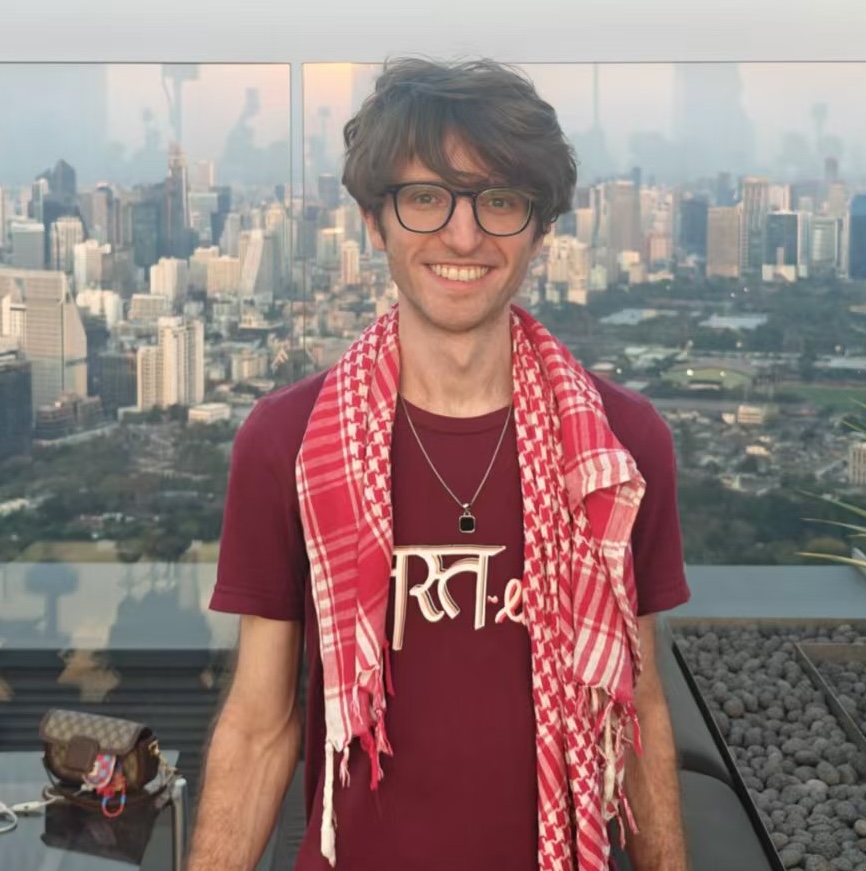
Andrew L. Miller is an assistant professor at the International Center for Theoretical Physics, Asia Pacific (ICTP-AP). His research interests include the detection of gravitational waves from neutron stars, primordial black holes binaries and particle dark matter. He is a member the LIGO-Virgo-KAGRA collaborations and a community member of the LISA consortium.
Office: Room 214, Building 7, No.80, Zhongguancun East Street, Haidian District, Beijing, China
Email: andrew.miller.ligo@ucas.ac.cn
For additional details not present on this page, please visit my personal website or my ICTP-AP profile page.
Research Areas
Searches for gravitational waves with LIGO, Virgo and KAGRA from:
- Deformed, isolated neutron stars
- Sub-solar-mass ultra-compact binaries, e.g. primordial black holes
- Remnants of supernovae or binary-neutron-star mergers
- Mini-extreme-mass-ratio inspirals (mini-EMRIs)
- Boson clouds around rotating black holes
Primordial black holes
- Constraining the existence of asteroid-mass and planetary-mass primordial black holes with gravitational waves
- Developing methods to search for inspiraling sub-solar mass primordial black holes
Direct dark-matter detection with gravitational-wave interferometers
- Interaction of vector dark photon dark matter with baryons in LIGO mirrors
- Interaction of scalar, dilaton dark matter with electrons and photons in LIGO
- Impact of tensor dark matter on the interferometers
Machine learning
- Developing methods to detect long-lived gravitational waves from isolated neutron stars
- Developing techniques to generate, identify and mitigate glitches for glitches
Developing data analysis methods for future gravitational-wave detectors
- Looking for the long-lived inspirals of binary neutron stars
- Characterizing the impact of nonstationary noise on LISA/Taiji data analysis for white-dwarf binaries and other sources
A good way to begin to understand these various topics is reading a review article. Please have a look at my review articles on gravitational-wave probes of particle dark matter, primordial black holes, and neutron stars
Education
PhD, Physics
Sapienza University of Rome and University of Florida (November 2016 – October 2019)
Thesis: Using machine learning and the Hough transform to search for gravitational waves due to r-mode emission by isolated neutron stars.
Masters, Physics
University of Florida (August 2015 – December 2016)
Bachelors of Science, Physics
The College of New Jersey (August 2011 – May 2015)
Experience
Assistant Professor
ICTP-AP / UCAS (December 2025 – Present)
Postdoctoral Scholar
National Institute of Subatomic Physics (Nikhef) / Utrecht University (January 2023 – November 2025)
Responsibilities included:
- Anomaly detection and machine learning methods to classify different types of glitches in GW detectors.
- Advising Bachelors, Masters and PhD students
- Early warning for neutron star mergers in Einstein Telescope data
FSR Postdoctoral Fellow
Center for Cosmology, Particle Physics and Phenomenology (CP3), Université catholique de Louvain (January 2020 – December 2022)
Responsibilities included:
- Developing methods to detect dark matter interacting with gravitational-wave detectors and inspiraling primordial black holes;
- Advising students on searches for gravitational waves from vector boson clouds around black holes and a stochastic background
- Building up a gravitational-wave group, organizing seminars, mentoring students, diversity and outreach.
- Awarded two Belgian national fellowships and one international fellowship through the European Space Agency (ESA)
Publications
For a list of my publications, please see my personal website or my inspirehep page.
Research group
My research group currently consists of:
Postdocs:
Three postdocs have been recruited and will start in Sept. 2026
PhD students:
Charchit Kumar Sethi (Sept. 2025- present)
One or two students to be recruited in July 2026
Masters students:
One student to be recruited in July 2026
Research Assistants:
Hang Yang (July 2025-present)
If you are interested in joining the group, please send me an email at: andrew.miller.ligo@ucas.ac.cn